Saturn reigns over the sky all night long
In October, the sun no longer exceeds the celestial equator at solar noon (passage to the meridian). This month, it crosses the constellation of Virgo.
The duration of the night increases by almost 1h30 between the beginning and end of the month.
In the sky
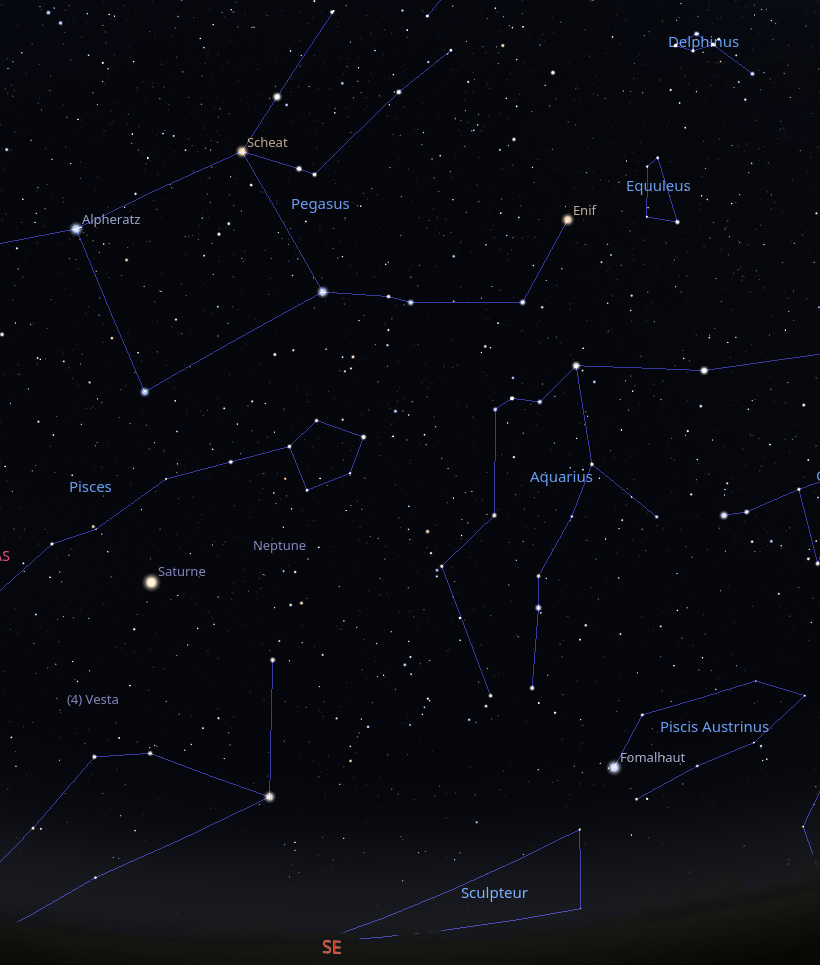
- Saturn is located in front of the constellation of Pisces, not far from the vernal point. To easily find it, read Pegasus’s description.
On October 4, Saturn is in opposition: it rises just as the Sun sets. The distance between the Earth and Saturn is, at that time, the smallest of the year.
On October 23, the Moon - gibbous - will be very close to the vernal point and above to the right of Saturn.
On October 24, the Moon - gibbous, almost full - will be very close to Saturn just above on the left.
- Venus is no longer visible because it is too close to the sun, but we will find it back in a few weeks in the morning...
The constellation of Pegasus – the winged horse of mythology – accompanies the planet Saturn throughout the night. The "square of Pegasus" forms a diamond above the East/Southeast horizon at the beginning of night. Saturn shines brightly right below.
One of the stars of the square of Pegasus, Alpheratz is actually part of the constellation of Andromeda.
The constellation of Andromeda is easy to find from the square of Pegasus: from Alpheratz, we extend the upper edge of the square towards the North, under the W of Cassiopeia. We easily discern 3 stars that form with Alpheratz the longest line in the constellation of Andromeda.
Mirach, the second star after the square of Pegasus has a beautiful orange glow. From it, if we draw a perpendicular to the great line of the constellation, we see 2 weaker stars, close by. Above the right of the second star, a white spot can be seen: it is the Andromeda galaxy. It is possible to observe it with binoculars.
In October, the Summer Triangle is still in the sky at the beginning of night, but it approaches more and more the western horizon at nightfall. It is composed of:
- Vega, α Lyrae, white star in the constellation of Lyra
- Deneb, α Cygni, white supergiant star, from the constellation of Swan
- Altaïr, α Aquilae, white star in the constellation of Aquila, closest to the southern horizon
Its tip, Altaïr, aims between the constellations of Sagittarius and Capricorn
Spotlight on Greco-Roman mythology
The month of October offers us the constellations of Cassiopeia, Cepheus and Andromeda above the northeastern horizon: a family story because Andromeda is the daughter of Cassiopeia and Cepheus king of Ethiopia. The sea monster Cetus to which she is offered as a sacrifice is not very far to the southeast under the Pisces.
Pegasus is also linked to them because he was born from the blood of the Gorgon Medusa, when she was decapitated by... the hero Perseus, whose constellation follows that of Andromeda whom he saved from the sea monster.
The circle is complete!